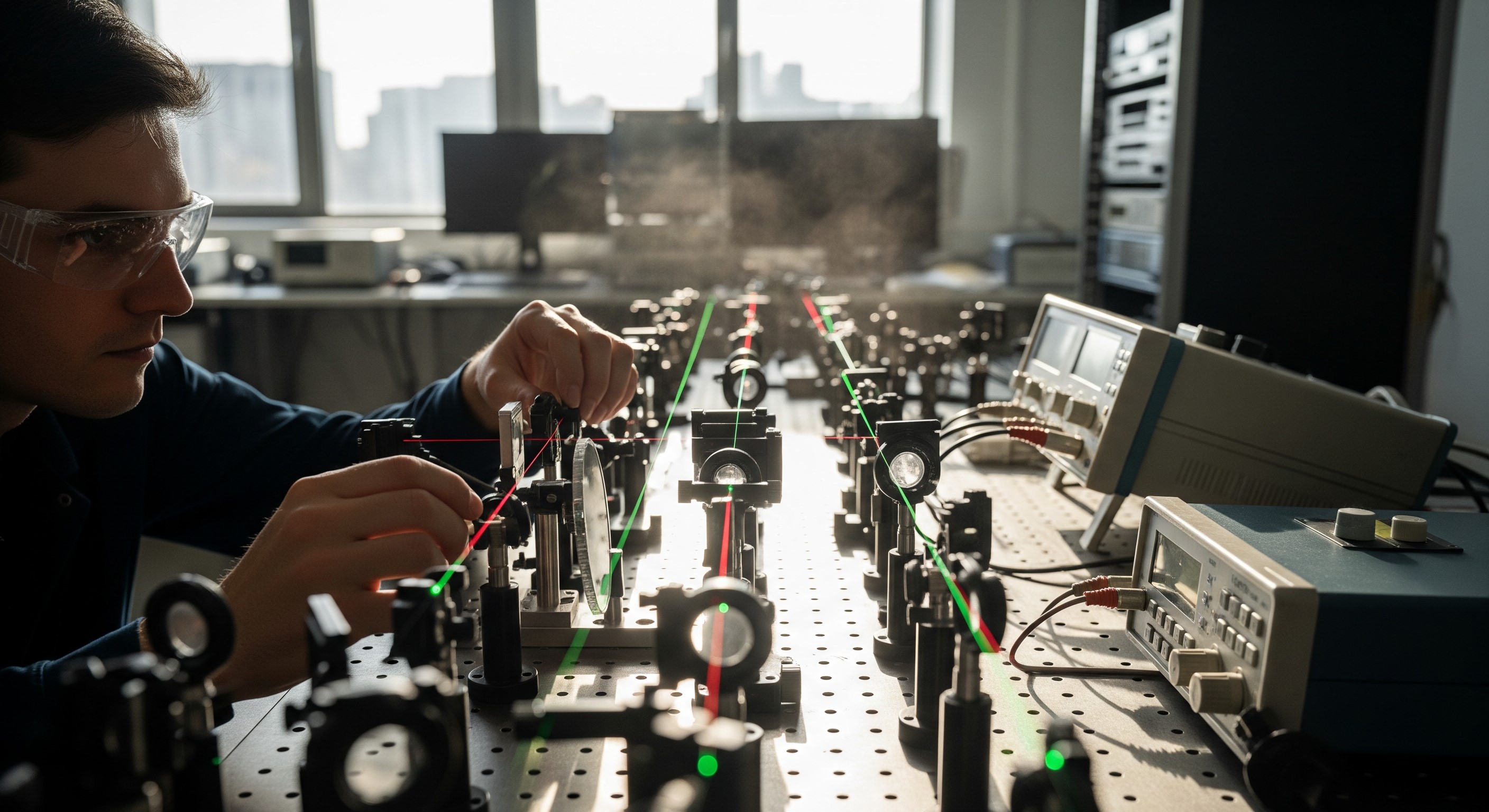
Optical Engineer
a guide to: Career
What is a Optical Engineer?
An Optical Engineer designs and develops devices that utilize the properties of light. They apply physics and mathematics to create systems like high-speed fiber-optic networks, medical lasers, and advanced camera lenses, ensuring these technologies manipulate light accurately, efficiently, and safely.
Why is a Optical Engineer important?
Optical engineering is essential as it enables the transmission of vast amounts of data across the globe via fiber optics. It also advances life-saving medical procedures through precise laser surgery and diagnostic imaging, revolutionizing modern science.
- High-Speed Data:
- Powers the global internet and communication networks through fiber-optic cables, laser systems, and satellite-based optical communication.
- Medical Precision:
- Enables minimally invasive surgeries and advanced diagnostic technologies such as MRI systems, endoscopes, laser surgery, and optical imaging tools.
- Cutting-Edge Tech:
- Essential for the development of VR/AR headsets, autonomous vehicle sensors (LiDAR), smartphones, cameras, and advanced optical sensors.
- Scientific Discovery:
- Facilitates deep-space exploration through powerful telescopes and enables high-resolution scientific research using advanced optical microscopes and imaging systems.
Ultimately, Optical Engineers bridge the gap between light science and practical application. Their work is the invisible foundation of the digital age, making global communication instantaneous and healthcare more precise.

Education Pathways
Option 01
Stream

Important Subjects
| # | Subject |
|---|---|
| 1 | Geometrical Optics – Study of ray behavior including reflection, refraction, image formation, and lens systems. |
| 2 | Physical Optics – Covers wave optics concepts such as interference, diffraction, polarization, and coherence phenomena. |
| 3 | Laser Engineering – Design, operation, and applications of laser sources across scientific and industrial domains. |
| 4 | Fiber Optics – Principles of light transmission through optical fibers for communication and sensing systems. |
| 5 | Optical Materials – Study of properties, selection, and performance of materials used in optical components and devices. |
| 6 | Photonic Devices – Design and development of LEDs, lasers, photodetectors, modulators, and integrated optical components. |
| 7 | Optical Instrumentation – Development and application of microscopes, telescopes, spectrometers, and advanced imaging systems. |
| 8 | Optical System Design – Design, analysis, and optimization of complete optical systems for performance and accuracy. |
| 9 | Fourier Optics – Analysis of optical systems using Fourier transform techniques for imaging and signal processing. |
| 10 | Optoelectronics – Study of interaction between light and electronic devices and circuits. |
| 11 | Image Processing – Enhancement, analysis, and interpretation of images using optical and digital techniques. |
| 12 | Metrology and Testing – Measurement, alignment, calibration, and performance testing of optical systems and components. |
Where to study?
Career Progression for a Optical Engineer
Qualification Levels:
- B.Tech/B.E. for entry roles;
- M.Tech/M.E. and certifications added advantage.
Role Levels & Growth:
- Entry Level: Graduate Optical Engineer - Design / Test Engineer
- Mid-Level: Senior Optical Engineer - Lead Engineer / Scientist
- Senior Level: Scientist / Professor - Principal Scientist
- Executive Level: Research Fellow - R&D Director
Further Opportunities:
- Roles in patent law, academic research, or specialized consulting for aerospace and defense.
Sectors Offering
- Fiber-Optic Communication: Design, deployment, and maintenance of optical fiber networks for high-speed internet, data transmission, and telecommunication systems.
- Photonics and Semiconductor Industry: Development of photonic integrated circuits, optical chips, lasers, and semiconductor-based optical devices.
- Medical Imaging and Healthcare Devices: Design and application of optical imaging systems, endoscopes, diagnostic instruments, and laser-based medical equipment.
- Defense and Surveillance: Optical and photonic technologies for surveillance systems, night vision, targeting, laser guidance, and secure communication.
- Aerospace and Space Research: Development of optical sensors, telescopes, satellite imaging systems, and space-based communication technologies.
- Laser Manufacturing and Processing: Industrial applications of lasers in cutting, welding, marking, additive manufacturing, and material processing.
- Scientific Research Laboratories: Research roles in optics, photonics, imaging, spectroscopy, and fundamental physics at academic and national labs.
- Consumer Electronics and Imaging: Design of cameras, smartphone optics, displays, AR/VR systems, and imaging sensors for consumer devices.
Expected Salary
Entry Level
- ₹4.5 - ₹9.0 LPA
Mid-Level
- ₹12.0 - ₹25.0 LPA
Senior Level
- ₹30.0 - ₹60.0 LPA
International
Entry Level
- $75,000 - $90,000 per annum
Mid/Senior Level
- $100,000 - $200,000 per annum
Design by Find Right Path