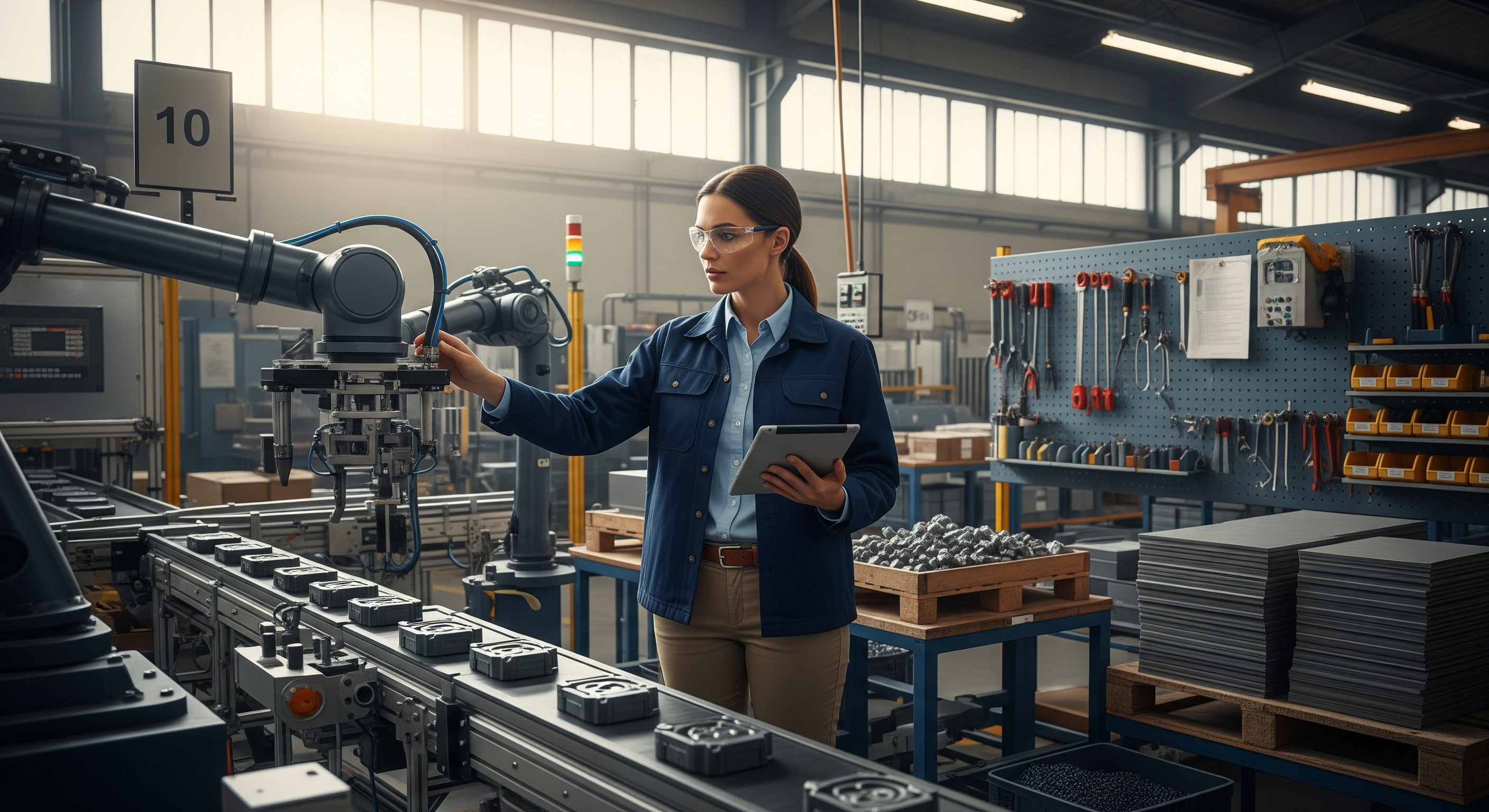
Manufacturing Engineer
a guide to: Career
What is a Manufacturing Engineer?
A Manufacturing Engineer is a professional who designs, operates, and optimizes the systems that transform raw materials into finished products. They focus on improving production efficiency, ensuring high quality, and integrating advanced technologies like robotics and automation to maximize industrial output.
Why is a Manufacturing Engineer important?
Manufacturing Engineers are the backbone of the production floor. They bridge the gap between product design and physical creation, ensuring that complex items are manufactured safely, cost-effectively, and sustainably for the global market.
- Process Optimization:
- Streamlines production lines to eliminate waste, improve workflow efficiency, and reduce overall manufacturing lead times.
- Quality Control:
- Implements rigorous inspection methods, testing procedures, and quality standards to ensure every unit meets customer and industry specifications.
- Automation Integration:
- Deploys smart manufacturing technologies, automation systems, and robotics to improve precision, productivity, and worker safety.
- Cost Management:
- Identifies economical materials, optimized processes, and energy-efficient methods to reduce production costs and lower the final product price.
As industry 4.0 matures, Manufacturing Engineers are essential for building the "Smart Factories" of the future, where data-driven decisions drive global competitiveness, environmental sustainability, and technological innovation.

Education Pathways
Option 01
Stream

Important Subjects
| # | Subject |
|---|---|
| 1 | Casting & Joining – Techniques for shaping molten metals and joining components through welding, brazing, and soldering processes. |
| 2 | Machining Science – Principles of material removal using CNC lathes, milling machines, drilling, and advanced machining processes. |
| 3 | Metrology – The science of high-precision measurement, inspection, tolerances, and quality assurance in manufacturing. |
| 4 | Tool Design – Designing jigs, fixtures, dies, molds, and special tools to improve production accuracy and efficiency. |
| 5 | CAD / CAM – Using computer-aided design and manufacturing software for product modeling, process planning, and automated machining. |
| 6 | Robotics & Automation – Integration of industrial robots, sensors, PLCs, and automated systems in modern assembly lines. |
| 7 | Materials Science – Studying the properties and behavior of metals, polymers, ceramics, and composites used in manufacturing. |
| 8 | Industrial Engineering – Optimizing plant layout, workflow, productivity, ergonomics, and human–machine interaction. |
| 9 | Thermodynamics – Analyzing heat transfer, energy utilization, and thermal processes involved in manufacturing operations. |
| 10 | Forming Processes – Shaping materials through rolling, forging, extrusion, sheet-metal forming, and bulk deformation techniques. |
| 11 | Mechatronics – Integration of mechanical systems, electronics, sensors, and software for smart manufacturing machinery. |
| 12 | Operations Research – Applying mathematical models to optimize production scheduling, inventory control, logistics, and supply chains. |
Career Progression for a Manufacturing Engineer
Qualification Levels:
- B.Tech/B.E. for entry roles;
- M.Tech/M.E. or certifications add advantage.
Role Levels & Growth:
- Entry - Manufacturing Engineer / Production Engineer - Shop-floor exposure
- Mid-Level - Process / Manufacturing Engineer - Process ownership
- Senior - Senior Manufacturing Engineer - System optimization
- Lead - Manufacturing Manager - Plant leadership
- Expert - Plant Head / Operations Director - Strategic management
Further Opportunities:
- Process Engineer
- Senior Engineer
- Lead Engineer
- Operations Manager
- Entrepreneurship
Sectors Offering
- Automotive & Auto Components: Manufacturing engines, chassis, transmission systems, precision components, and assemblies using advanced production technologies.
- Aerospace & Defense Manufacturing: Producing high-precision aircraft structures, propulsion components, defense equipment, and mission- critical systems under strict quality standards.
- Heavy Engineering & Machinery: Fabrication and assembly of industrial machinery, construction equipment, and heavy-duty mechanical systems.
- Consumer Durables & Appliances: Mass production of household appliances, electrical goods, and consumer products with a focus on cost, quality, and reliability.
- Electronics & Semiconductor Manufacturing: Precision manufacturing of electronic components, PCBs, semiconductor devices, and microelectronic assemblies.
- FMCG & Packaging: High-volume manufacturing of fast-moving consumer goods, packaging materials, and automated production lines.
- Steel, Cement & Metals: Large-scale processing and production of metals, alloys, cement, and construction materials using continuous manufacturing processes.
- Renewable Energy Equipment Manufacturing: Manufacturing solar panels, wind turbine components, energy storage systems, and green energy equipment.
Expected Salary
Entry Level
- ₹3.0 - ₹6 LPA
Mid-Level
- ₹7.0 - ₹14.0 LPA
Senior Level
- ₹18.0 - ₹35.0 LPA
International
Entry Level
- $60,000 - $75,000 per annum
Mid/Senior Level
- $85,000 - $170,000 per annum
Design by Find Right Path